
Best GPU for AOC 2K 240Hz Monitor: Which Cards Actually Hit 240 FPS at QHD?
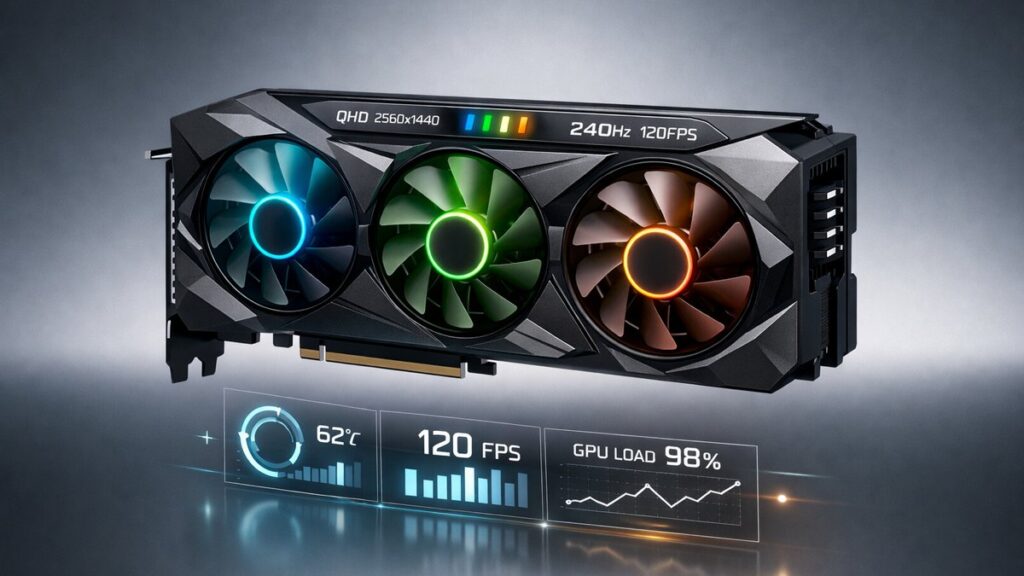
Sustaining 240 FPS at 2560×1440 (QHD) demands a high-end discrete GPU. The RTX 4070 Super and RX 7900 GRE are the minimum practical options for competitive titles; the RTX 4080 Super or RX 7900 XTX is required for AAA games at maximum settings. Mid-range cards consistently drop below 144 FPS at QHD in demanding scenes.
GPU vs. AOC 240Hz QHD Monitor: At-a-Glance Comparison
| GPU | Avg FPS @ QHD (Competitive) | Avg FPS @ QHD (AAA Max) | VRAM | DLSS / FSR | Tier |
|---|---|---|---|---|---|
| NVIDIA GeForce RTX 4090 | 300+ FPS | 160–200 FPS | 24 GB GDDR6X | DLSS 3.5 | Flagship |
| NVIDIA GeForce RTX 4080 Super | 270–300 FPS | 130–165 FPS | 16 GB GDDR6X | DLSS 3.5 | High-end |
| NVIDIA GeForce RTX 4070 Ti Super | 240–270 FPS | 110–145 FPS | 16 GB GDDR6X | DLSS 3.5 | High-end |
| NVIDIA GeForce RTX 4070 Super | 210–250 FPS | 90–120 FPS | 12 GB GDDR6X | DLSS 3.5 | Upper-mid |
| AMD Radeon RX 7900 XTX | 260–290 FPS | 130–160 FPS | 24 GB GDDR6 | FSR 3 | High-end |
| AMD Radeon RX 7900 GRE | 200–240 FPS | 85–115 FPS | 16 GB GDDR6 | FSR 3 | Upper-mid |
| NVIDIA GeForce RTX 4070 | 180–220 FPS | 75–100 FPS | 12 GB GDDR6X | DLSS 3.5 | Mid-range |
| AMD Radeon RX 7800 XT | 160–200 FPS | 70–95 FPS | 16 GB GDDR6 | FSR 3 | Mid-range |
FPS ranges reflect benchmarks across Valorant, Counter-Strike 2, Fortnite, Cyberpunk 2077, and Hogwarts Legacy at QHD with high-to-ultra settings. Competitive titles use lower graphical presets to maximize frame rates.
Which GPU Should You Buy? Decision Matrix by Use Case
- If you play competitive shooters (Valorant, CS2, Apex Legends) and need a consistent 240+ FPS average → RTX 4070 Super or RX 7900 GRE, because both clear 200 FPS in e-sports titles at QHD with minimal tuning.
- If you split time between competitive and AAA single-player titles at high settings → RTX 4070 Ti Super or RX 7900 XTX, because the 16 GB VRAM buffer handles texture-heavy open-world games without VRAM compression artifacts.
- If you want guaranteed 240 FPS in virtually every title including Cyberpunk 2077 with RT enabled → RTX 4080 Super, because DLSS 3.5 Frame Generation pushes effective output past 240 FPS even in ray-traced scenes.
- If budget is the primary constraint and you accept using FSR 3 or DLSS upscaling to reach 240 FPS → RTX 4070 or RX 7800 XT, because both cards deliver native 144–200 FPS in competitive titles and reach 240 FPS with Quality-mode upscaling active.
- If future-proofing for next-generation titles at QHD or possible 4K upgrade → RTX 4090 with 24 GB GDDR6X, because the GPU maintains flagship performance headroom beyond any AOC QHD 240Hz panel’s capabilities.
- If you use AMD-exclusive features like Radeon Anti-Lag 2 or prefer open-source upscaling → RX 7900 XTX, because FSR 3 works across any game with an FSR integration, including older titles.
[amazon_rapid query=”GPU RTX 4070 Super RX 7900 GRE graphics card” brand=”” layout=”magazine” cols=”2″ country=”US” lang=”en_US” max_pages=”1″ per_page=”4″ sort_by=”RELEVANCE” show_variants=”0″]
Key Specs Explained: What Makes a GPU Viable at QHD 240Hz?
Why Does Raw Rasterization Performance Set the Baseline?
Rasterization throughput — measured in shader TFLOPS and memory bandwidth (GB/s) — directly determines how many frames per second a GPU renders before upscaling or frame generation assists.
- RTX 4080 Super: 52.2 shader TFLOPS, 736 GB/s bandwidth via 256-bit GDDR6X bus.
- RTX 4070 Ti Super: 44.1 shader TFLOPS, 672 GB/s bandwidth via 256-bit GDDR6X bus.
- RX 7900 XTX: 61.4 shader TFLOPS, 960 GB/s bandwidth via 384-bit GDDR6 bus.
- RX 7900 GRE: 45.9 shader TFLOPS, 576 GB/s bandwidth via 256-bit GDDR6 bus.
- RTX 4070 Super: 35.5 shader TFLOPS, 504 GB/s bandwidth via 192-bit GDDR6X bus.
How Does VRAM Capacity Affect QHD Gaming?
At 2560×1440 with high-to-ultra texture packs, modern AAA titles consume 8–12 GB of VRAM. Cards with only 8 GB (e.g., RTX 4060 Ti 8 GB) compress textures to system RAM, causing frame-time spikes that disrupt high-refresh gameplay even if average FPS looks acceptable.
- 12 GB GDDR6X (RTX 4070, RTX 4070 Super): adequate for QHD competitive and most AAA titles at high settings.
- 16 GB GDDR6X / GDDR6 (RTX 4070 Ti Super, RTX 4080 Super, RX 7900 GRE, RX 7800 XT): comfortable headroom for ultra-texture packs and modded titles.
- 24 GB GDDR6X / GDDR6 (RTX 4090, RX 7900 XTX): eliminates VRAM pressure for any current QHD workload and supports future AAA titles.
DLSS 3.5 vs. FSR 3: Which Upscaling Tech Helps More at 240Hz?
DLSS (Deep Learning Super Sampling) version 3.5 uses dedicated Tensor Cores on NVIDIA Ada Lovelace GPUs to reconstruct frames with minimal latency penalty. FSR (FidelityFX Super Resolution) version 3 uses a temporal algorithm executable on any GPU, including NVIDIA hardware.
- DLSS 3.5 Frame Generation (RTX 40-series exclusive): inserts AI-generated frames between rendered frames, effectively doubling perceived frame rate. Most impactful when native FPS is already 100–140, pushing output to 200–280 FPS displayed.
- DLSS Super Resolution Quality mode: upscales from ~1706×960 to 2560×1440. Image quality is near-native at QHD; latency overhead under 1 ms on RTX 4070-class hardware.
- FSR 3 Frame Generation: works on NVIDIA and AMD GPUs alike; image quality slightly below DLSS at equivalent modes but game-compatible without RTX hardware requirement.
- FSR 3 Quality mode: upscales from ~1706×960 to 2560×1440 with a minor softness penalty versus DLSS, acceptable for competitive play where motion clarity matters more than static detail.
Does Display Connectivity Matter for AOC QHD 240Hz Monitors?
AOC’s QHD 240Hz lineup — including the AOC Q27G3XMN and AOC AG275QXN — uses DisplayPort 1.4 with DSC (Display Stream Compression) or DisplayPort 2.1 to sustain 2560×1440 at 240Hz without signal loss. Every GPU in the RTX 40-series and RDNA 3 generation supports DisplayPort 1.4 as a minimum; RTX 4090, RX 7900 XTX, and RX 7900 GRE include DisplayPort 2.1 outputs natively.
- DisplayPort 1.4 + DSC: sufficient bandwidth for 2560×1440 at 240Hz; supported by all RTX 40-series and RX 7000-series cards.
- DisplayPort 2.1: uncompressed 2560×1440 at 240Hz and headroom for higher resolutions; available on RX 7900-series and RTX 4090.
- HDMI 2.1: supports 2560×1440 at 240Hz on monitors with HDMI 2.1 ports; RTX 40-series and RX 7000-series both include HDMI 2.1 outputs.
How Important Is the CPU When Pairing a GPU with a 240Hz QHD Monitor?
At 240 FPS targets, CPU bottlenecks become significant. A slow processor caps frame output regardless of GPU performance — a condition called a CPU bottleneck. For sustained 240 FPS in competitive titles, pair any GPU above with an Intel Core i5-13600K, Core i7-13700K, AMD Ryzen 5 7600X, or Ryzen 7 7800X3D minimum. The Ryzen 7 7800X3D’s 3D V-Cache architecture delivers the highest average and 1% low FPS in CPU-bound games like CS2 and Valorant.
Pros and Cons by GPU Option
RTX 4070 Super — Pros
- Clears 240 FPS in most e-sports titles at QHD natively
- DLSS 3.5 Frame Generation bridges the gap in AAA titles
- 12 GB GDDR6X sufficient for QHD high settings without VRAM spikes
- Lower power draw (220W TDP) versus RTX 4070 Ti Super at 285W
RTX 4070 Super — Cons
- Falls below 240 FPS in Cyberpunk 2077 and Hogwarts Legacy at ultra settings without DLSS
- 12 GB VRAM may constrain heavily modded or next-gen AAA titles
- No DisplayPort 2.1 output (uses DP 1.4a with DSC)
RTX 4080 Super — Pros
- Sustained 240+ FPS average in virtually all QHD competitive titles natively
- 16 GB GDDR6X eliminates VRAM bottlenecks at QHD ultra settings
- DLSS 3.5 Frame Generation enables effective 240+ FPS in ray-traced AAA titles
- Viable for a future 4K 144Hz upgrade without GPU replacement
RTX 4080 Super — Cons
- 320W TDP requires a quality 850W+ PSU and good case airflow
- Significant price premium over RTX 4070 Ti Super for marginal QHD gains
- Overkill for users playing exclusively e-sports titles at QHD
RX 7900 XTX — Pros
- 24 GB GDDR6 at 960 GB/s bandwidth — highest memory throughput in this list
- DisplayPort 2.1 output for uncompressed QHD 240Hz signal
- FSR 3 compatibility extends to non-AMD hardware and older game libraries
- Strong native rasterization without reliance on Frame Generation
RX 7900 XTX — Cons
- No Frame Generation equivalent to DLSS 3.5 in ray-traced titles
- 355W TDP — highest power consumption in this comparison
- FSR 3 image quality slightly below DLSS Super Resolution in direct comparisons
RX 7900 GRE — Pros
- 16 GB GDDR6 at a price point closer to RTX 4070 Super
- Reaches 240 FPS in competitive titles at QHD natively
- DisplayPort 2.1 output included
RX 7900 GRE — Cons
- Falls short of consistent 240 FPS in demanding AAA titles at ultra settings
- FSR 3 Frame Generation less polished than DLSS 3.5 in motion-heavy scenes
- Limited ray-tracing performance versus RTX 4070 Ti Super at similar price
Should You Upgrade Your GPU Before Buying an AOC 240Hz QHD Monitor?
Before committing to a panel, review the full specs and panel options in the AOC 2K 240Hz monitor hub to match response time, panel type (IPS vs. VA), and HDR tier to your use case alongside your GPU choice.
It is also worth evaluating whether a 240Hz 2K monitor fits your budget before pairing it with a high-end GPU purchase — a 165Hz or 180Hz QHD monitor may deliver equal perceived smoothness at competitive framerates for less total system cost.
Pre-Purchase GPU Buying Checklist for QHD 240Hz Gaming
- Confirm your monitor model’s maximum certified refresh rate and whether it uses DisplayPort 1.4 with DSC or DisplayPort 2.1 — check the manufacturer spec sheet for the AOC AG275QXN or Q27G3XMN as applicable.
- Verify your PSU wattage: RTX 4070 Super requires a 650W minimum; RTX 4080 Super and RX 7900 XTX require 850W minimum rated units from reputable manufacturers (Seasonic, Corsair, be quiet!).
- Check your CPU against the GPU tier: pairing an RTX 4080 Super with an Intel Core i5-12400 will create a CPU bottleneck above 200 FPS in CS2 and Valorant. Upgrade to a Ryzen 7 7800X3D or Core i7-13700K simultaneously if needed.
- Determine your primary game library: if 80%+ of play time is e-sports titles (Valorant, CS2, Apex Legends, Overwatch 2), the RTX 4070 Super or RX 7900 GRE is sufficient and avoids overspending on RTX 4080 Super-class hardware.
- Assess upscaling compatibility: verify your target game library supports DLSS 3.5 or FSR 3 — check NVIDIA’s official DLSS game list and AMD’s FSR-supported titles page before relying on Frame Generation to hit 240 FPS.
- Measure case clearance: RTX 4080 Super and RX 7900 XTX reference or AIB cards frequently exceed 320 mm in length and 3.5 slots in thickness — confirm compatibility with your PC case spec sheet.
- Check PCIe slot version: RTX 40-series and RX 7000-series GPUs use PCIe 4.0 ×16; they are backward compatible with PCIe 3.0 ×16 with a 5–10% throughput reduction at QHD, which is generally negligible at 240Hz targets.
Common Questions
Can an RTX 3080 or RX 6800 XT sustain 240 FPS at QHD?
The RTX 3080 (10 GB) and RX 6800 XT (16 GB) average 160–210 FPS in competitive e-sports titles at QHD. Both fall short of a consistent 240 FPS without upscaling. DLSS 2 (RTX 3080) or FSR 2 (RX 6800 XT) at Quality mode can bridge the gap in titles that support those integrations.
Does an AOC QHD 240Hz monitor support AMD FreeSync or NVIDIA G-Sync?
Most AOC QHD 240Hz panels carry VESA Adaptive-Sync certification and are listed under AMD FreeSync Premium Pro. NVIDIA G-Sync Compatible mode is supported on RTX-series GPUs via the Adaptive-Sync standard, enabling variable refresh rate operation from approximately 48 Hz to 240 Hz on certified panels like the AOC AG275QXN.
Is 240Hz QHD noticeably smoother than 165Hz QHD with the same GPU?
The perceptual difference between 165Hz and 240Hz is measurable in motion clarity and input latency reduction — the frame interval drops from 6.06 ms at 165Hz to 4.17 ms at 240Hz. Competitive players with trained reaction times consistently identify the improvement in blind tests. Casual players may find 165Hz sufficient, making a GPU upgrade to reach 240 FPS less urgent.