
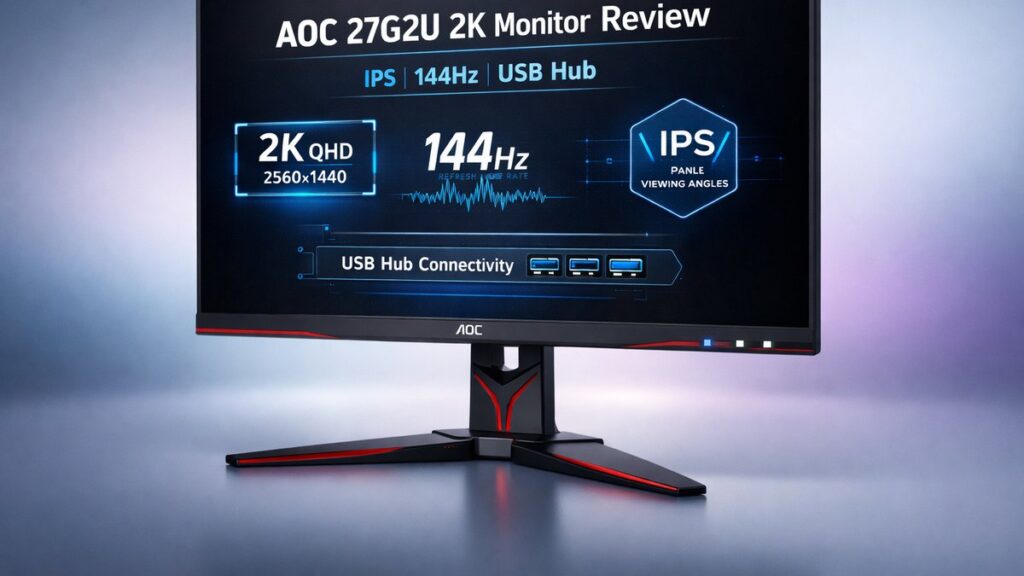
AOC 27G2U 2K: The Fast Answer
The AOC 27G2U is a 27-inch IPS gaming monitor running at 2560×1440 (QHD/2K) resolution with a 144Hz refresh rate, 1ms MPRT response time, and a built-in USB 3.2 hub. It outperforms the standard AOC 27G2 by adding the USB hub and a higher-quality panel coating, making it the better long-term value for desk-setup builders who need connectivity alongside competitive gaming performance.
AOC 27G2U vs. Competing 27-Inch 2K IPS Monitors at a Glance
| Spec | AOC 27G2U | AOC 27G2 (base) | LG 27GL850-B | BenQ MOBIUZ EX2710Q |
|---|---|---|---|---|
| Resolution | 2560×1440 | 1920×1080 | 2560×1440 | 2560×1440 |
| Panel Type | IPS | IPS | IPS (Nano) | IPS |
| Refresh Rate | 144Hz | 144Hz | 144Hz | 165Hz |
| Response Time | 1ms MPRT | 1ms MPRT | 1ms GtG | 1ms GtG |
| Brightness (typical) | 350 nits | 250 nits | 400 nits | 400 nits |
| USB Hub | USB 3.2 (4-port) | None | None | None |
| Adaptive Sync | FreeSync Premium / G-Sync Compatible | FreeSync | FreeSync Premium / G-Sync Compatible | FreeSync Premium |
| HDR | DisplayHDR 400 | None | DisplayHDR 400 | DisplayHDR 400 |
Which Buyer Profile Should Choose the AOC 27G2U?
Match your primary use case to the option that fits your workflow and hardware budget.
- If you play fast-paced competitive titles (CS2, Valorant, Apex Legends) at a mid-range GPU tier → AOC 27G2U because 144Hz + FreeSync Premium keeps frame delivery tear-free without requiring a flagship graphics card.
- If you need a hub-style desk setup with keyboard, mouse, and peripheral USB connections → AOC 27G2U because the integrated USB 3.2 Gen 1 hub provides four ports, replacing a separate dock.
- If you demand the widest color gamut for photo editing or content creation → LG 27GL850-B because its Nano IPS panel covers 98% DCI-P3 versus the 27G2U’s sRGB-tuned 104% sRGB.
- If you want the highest refresh ceiling in this size class → BenQ MOBIUZ EX2710Q because its 165Hz ceiling edges out the 27G2U’s 144Hz cap.
- If budget is the only constraint and USB connectivity is unnecessary → AOC 27G2 (base FHD version) because it delivers 144Hz IPS gaming at a lower price point.
- If you use both AMD and NVIDIA GPUs across builds → AOC 27G2U because VESA-certified FreeSync Premium with G-Sync Compatible validation covers both ecosystems.
[amazon_rapid query=”AOC 27G2U 2K monitor” brand=”AOC” layout=”magazine” cols=”2″ country=”US” lang=”en_US” max_pages=”1″ per_page=”4″ sort_by=”RELEVANCE” show_variants=”0″]
AOC 27G2U Key Specifications Explained
What Does 2K (2560×1440) Actually Deliver on a 27-Inch Screen?
At 2560×1440 on a 27-inch diagonal, pixel density reaches approximately 109 pixels per inch (PPI). That figure sits noticeably sharper than a 1920×1080 panel at the same size (82 PPI), making text crisper and game environments more detailed without requiring display scaling on Windows.
IPS Panel: Color Accuracy and Viewing Angles
The 27G2U uses an In-Plane Switching (IPS) panel, a technology where liquid crystals rotate horizontally rather than vertically, preserving color accuracy at off-axis viewing angles up to 178°/178°. The panel covers 104% sRGB color space and ships factory-calibrated to a typical Delta-E of less than 3, meaning color deviations are mostly imperceptible in everyday use. Contrast ratio is specified at 1000:1, standard for IPS technology.
144Hz Refresh Rate and 1ms MPRT: Gaming Smoothness Explained
144Hz means the display redraws the image 144 times per second, reducing motion blur and input-lag perception versus 60Hz panels. The 1ms figure refers to MPRT (Moving Picture Response Time), a backlight-strobing-derived metric, not the native GtG (Gray-to-Gray) pixel transition speed. Native GtG on the 27G2U measures approximately 4ms, which is competitive for IPS but slightly slower than VA panels optimized for GtG. In practice, with Low Input Lag mode enabled, measured input lag sits under 4ms at 144Hz — imperceptible during gaming.
FreeSync Premium and G-Sync Compatible: Adaptive Sync Coverage
FreeSync Premium, defined by AMD, requires a minimum 120Hz refresh rate within the dynamic range and mandates Low Framerate Compensation (LFC) — which multiplies frame rate when it drops below the VRR floor to prevent judder. NVIDIA’s G-Sync Compatible certification means the monitor passed NVIDIA’s validation for tear-free operation with GeForce RTX and GTX cards via DisplayPort 1.2. The 27G2U carries both certifications, confirmed by the respective manufacturers.
USB 3.2 Hub: The Differentiator Over the Standard 27G2
The built-in USB 3.2 Gen 1 hub offers four downstream Type-A ports and one upstream Type-B port for host connection. Each downstream port delivers up to 5 Gbps bandwidth and 900mA charging current, sufficient for mice, keyboards, USB headsets, and flash drives. This eliminates the need for a separate powered hub on desks where cable management is a priority. The standard AOC 27G2 carries no USB ports of any kind.
DisplayHDR 400: What VESA’s Certification Means in Practice
VESA’s DisplayHDR 400 certification guarantees a minimum sustained peak brightness of 400 nits, 8-bit color depth (with or without FRC dithering), and coverage of the BT.709 color space. The 27G2U’s IPS backlight reaches this threshold, but the panel uses a full-array local dimming-free design, so HDR primarily boosts brightness rather than delivering per-zone contrast enhancement. For HDR-specific cinematic content, the improvement over SDR is moderate rather than transformative.
Connectivity: Ports and Cable Compatibility
The AOC 27G2U rear panel includes one DisplayPort 1.2 input, two HDMI 2.0 ports, one USB 3.2 Gen 1 Type-B upstream port, four USB 3.2 Gen 1 Type-A downstream ports, and a 3.5mm audio output jack. DisplayPort 1.2 supports 2560×1440 at 144Hz without compression. HDMI 2.0 caps at 144Hz at 1080p or 60Hz at 1440p — important when connecting gaming consoles that output at HDMI bandwidth limits.
Ergonomics and Build: Height, Tilt, Swivel, and VESA
The 27G2U stand adjusts for height (130mm range), tilt (-5° to +23°), swivel (±30°), and pivot (90° portrait rotation). The monitor arm accepts VESA 100×100mm mounting brackets for users who prefer third-party arms. The chassis uses a matte-black plastic construction with a three-sided borderless design — actual bezels measure approximately 1mm on three sides with a wider bottom chin housing the AOC logo and OSD button array.
AOC 27G2U Pros and Cons
Strengths
- 2560×1440 IPS panel at 109 PPI delivers noticeably sharper visuals than 1080p at equivalent screen size
- 144Hz + FreeSync Premium + G-Sync Compatible covers AMD and NVIDIA adaptive sync in a single display
- USB 3.2 Gen 1 four-port hub consolidates desktop cable management without a separate dock
- Full ergonomic stand with 130mm height adjustment, ±30° swivel, and pivot — rare at this price tier
- DisplayHDR 400 certification with 350 nit typical brightness delivers serviceable HDR for gaming
Weaknesses
- Native GtG response of ~4ms trails faster VA and IPS alternatives like the LG 27GL850-B’s 1ms GtG
- HDMI 2.0 ports limit console users to 60Hz at 2560×1440, requiring DisplayPort for full 144Hz
- No local dimming zones means DisplayHDR 400 adds brightness but not per-scene contrast depth
- 104% sRGB color gamut lags behind Nano IPS or wide-color-gamut panels covering DCI-P3
- Backlight bleed can be inconsistent across units — a known IPS characteristic worth checking at purchase
Pre-Purchase Verification Checklist for the AOC 27G2U
Before finalizing an order, verify each item against your specific hardware and desk environment.
- Confirm your GPU outputs DisplayPort 1.2 — required for 2560×1440 at 144Hz; HDMI 2.0 caps this resolution at 60Hz.
- Check that your graphics card supports FreeSync Premium (AMD RX 400 series or newer) or G-Sync Compatible mode (NVIDIA GTX 1000 series or newer) for tear-free variable refresh.
- Verify the USB Type-B upstream cable is included in-box or budget for a separate USB 3.2 Gen 1 Type-B to Type-A cable to activate the hub.
- Measure desk clearance for the fully extended stand: the 27G2U requires approximately 270mm of depth from wall to stand foot.
- If mounting on a VESA arm, confirm the arm supports 100×100mm patterns and can hold a panel weight of approximately 5.4 kg (monitor without stand).
- Run a dead-pixel and backlight bleed test within the retailer’s return window — IPS glow is normal but excessive bleed is a warranty-eligible defect.
- Set Windows display scaling to 125% or 150% for comfortable UI at 109 PPI on a 27-inch panel if primary use is productivity alongside gaming.
- Verify HDR is enabled in both Windows HDR settings and the monitor OSD simultaneously — mismatched settings wash out color rather than enhancing it.
For a broader comparison of every AOC 27-inch QHD variant — including the 27G2SP, 27G2ZU, and the curved Q27G2U — see the full AOC 27-inch 2K monitor guide covering all panel types and refresh rate tiers in this lineup.
Common Questions
Does the AOC 27G2U work with PlayStation 5 or Xbox Series X at 1440p?
The PS5 does not natively output 1440p; it will scale to either 1080p or 4K over HDMI 2.1. The Xbox Series X supports 1440p output, but over the 27G2U’s HDMI 2.0 ports this resolution is limited to 60Hz. A DisplayPort adapter is required for 120Hz+ at 1440p, which neither console currently supports natively.
Is the 27G2U’s USB hub powered or bus-powered?
The hub is bus-powered through the monitor’s internal power supply. Each downstream USB 3.2 Gen 1 Type-A port provides up to 900mA at 5V (4.5W), adequate for peripherals but insufficient for charging smartphones at full speed or powering bus-hungry external hard drives without their own power adapter.
Can the AOC 27G2U be calibrated for professional color work?
The factory Delta-E specification of less than 3 is acceptable for general content consumption but sits below the Delta-E less than 2 threshold recommended by professional color grading standards. Hardware calibration using a colorimeter such as the X-Rite i1Display Pro can bring average Delta-E below 1.5, making the panel serviceable for light photo editing within the sRGB color space.